
 Which wood is best for Wood frame construction? Timber choices for framing homes are varied… © Jaksmata
LUMBER CHOICES FOR WOOD FRAME CONSTRUCTION – CHOOSING TIMBER FOR FRAMING & BUILDING HOMES
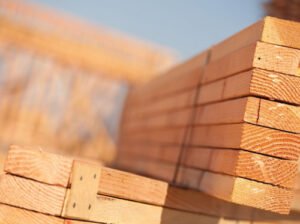
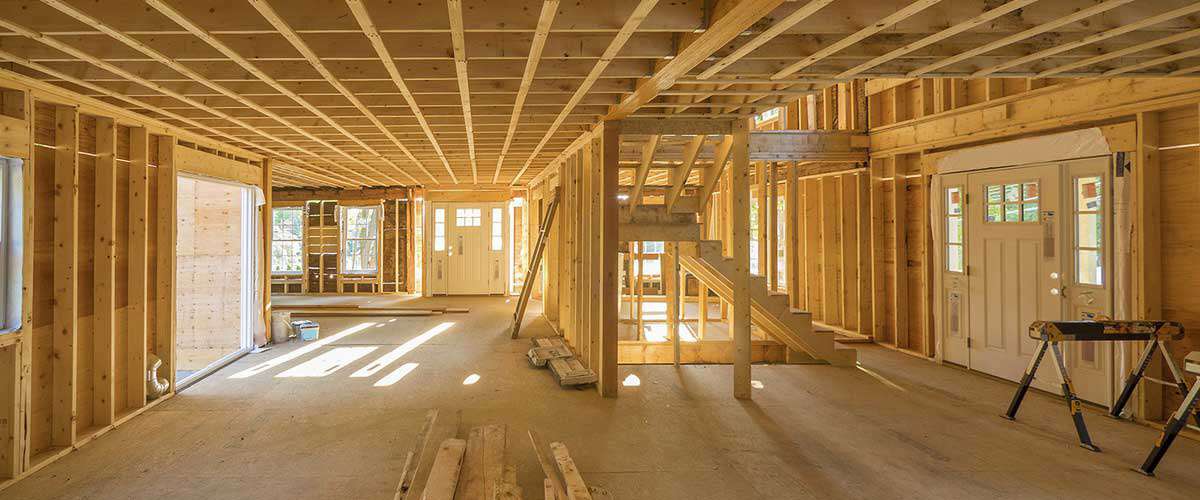
Framing lumber, also known as structural wood, is the grade of wood used for house framing (studs, Larsen Trusses for Double-Stud walls, headers, roof trusses and floor joists, etc. as well as in timber frame construction). Its technical characteristics make it perfectly suitable when large spans are necessary. The list below outlines the different types of wood used as framing lumber most commonly used for house construction and increasingly in timber frames for multi-family low to mid-rise construction throughout the US and Canada.
Standard SPF (spruce-pine-fir) lumber – Softwood wood choices:
- Light structural lumber is mainly used in the residential construction of single family homes. This timber is milled from softwood trees (spruce, fir and pine) that are sawn and machine-planed to standard dimensions (2×4″, 2×6″, 2×8″, etc.). Wood as a framing material is advantageous in that it doesn’t undergo much transformation during processing, it has a low embodied energy, it’s a renewable resource and it stores carbon.
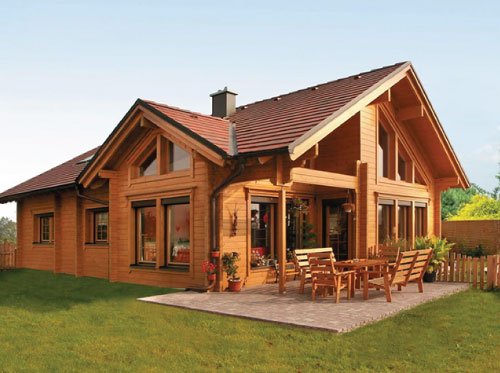
- Heavy timber refers to any dimensional lumber over 4.5″ and is often used for post-and-beam construction or timber frame homes. Large dimensions of wood can support heavy loads and facilitate long spans, in addition to being surprisingly fire resistant.
- Finger-jointed lumber (also known as end-jointed and end-glued) is manufactured using short, dry pieces of wood that have been machined on each end and joined using a water repellent structural adhesive. This technique is ecologically beneficial, as it makes use of short pieces of wood to create a finished product that is larger, more stable and easier to align, and is often combined with Glulam and CLT type products to make substantial timber structural elements for “Plyscrapers” etc – (see below).
The real dimensions of light structural lumber and timber for framing homes:
A constant source of confusion amongst DIY Home builders is lumber sizes, as commercially available 2×4″ is actually 1.5″ x 3.5″, a 2×6 is actually 1.5″ x 5.5″. The general rule of thumb: any width listed as 2″ will actually be 1.5″ and as for the depth, actual dimensions are .5″ less. The reason for this is planing; some true dimensions can be found at lumber yards, referred to as ‘rough’ lumber or “rough sawn” as they are unplaned wood.
| Dimensional Lumber: Nominal Size vs. Actual Size | |
|---|---|
| Nominal Size | Actual Size |
| Two-by-four or 2 x 4 | 1 1/2 inches x 3 1/2 inches |
| Two-by-six or 2 x 6 | 1 1/2 inches x 5 1/2 inches |
| Two-by-eight or 2 x 8 | 1 1/2 inches x 7 1/4 inches |
| Two-by-ten or 2 x 10 | 1 1/2 inches x 9 1/4 inches |
| One-by-two or 1 x 2 | 3/4-inch x 1 1/2 inches |
| One-by-three or 1 x 3 | 3/4-inch x 2 1/2 inches |
| One-by-four or 1 x 4 | 3/4-inch x 3 1/2 inches |
Here’s another confusing anomoly when looking at choosing wood for framing, Canadian Lumber Standard timber commonly referred to as CLS wood timber became popular in Canada for building strong and durable timber-framed homes but is rarely referred to as CLS lumber in North America. This timber is usually manufactured from kiln-dried fir, pine, or spruce. It is then treated, planed, and finally finished with rounded edges to create accurate and precise tolerances. This type of wood is known to provide aesthetically pleasing finishes and facilitate easier and comfortable application of paint, stains, and preservatives & in recent years CLS timber has become popular in the United Kingdom and Europe where it is mainly used in timber-frame construction, internal partitioning, framing, and carcassing. This wood is also ideal for internal stud walling since it is surfaced on all of its four sides and it has rounded corners. The CLS timber is produced in a wide range of sizes that suit various uses. This product has also been machined on all of its four faces and edges to create beautiful finishes – very unlike the rough-sawn timber usually found in Europe.
Grading Wood in Uk & Europe
The CLS timber is usually graded in respect to its strength in strict conformity to the British Standard EN 14081-1:2005. This wood can be graded as either C16 or C24. The C24 is the stronger grade, but both categories tend to have a similar physical appearance.